
Customer Service Agent or Human Flow? How to Decide the Right Role for Automation
A practical framework to define where automation adds value in customer service and where human contact remains essential.
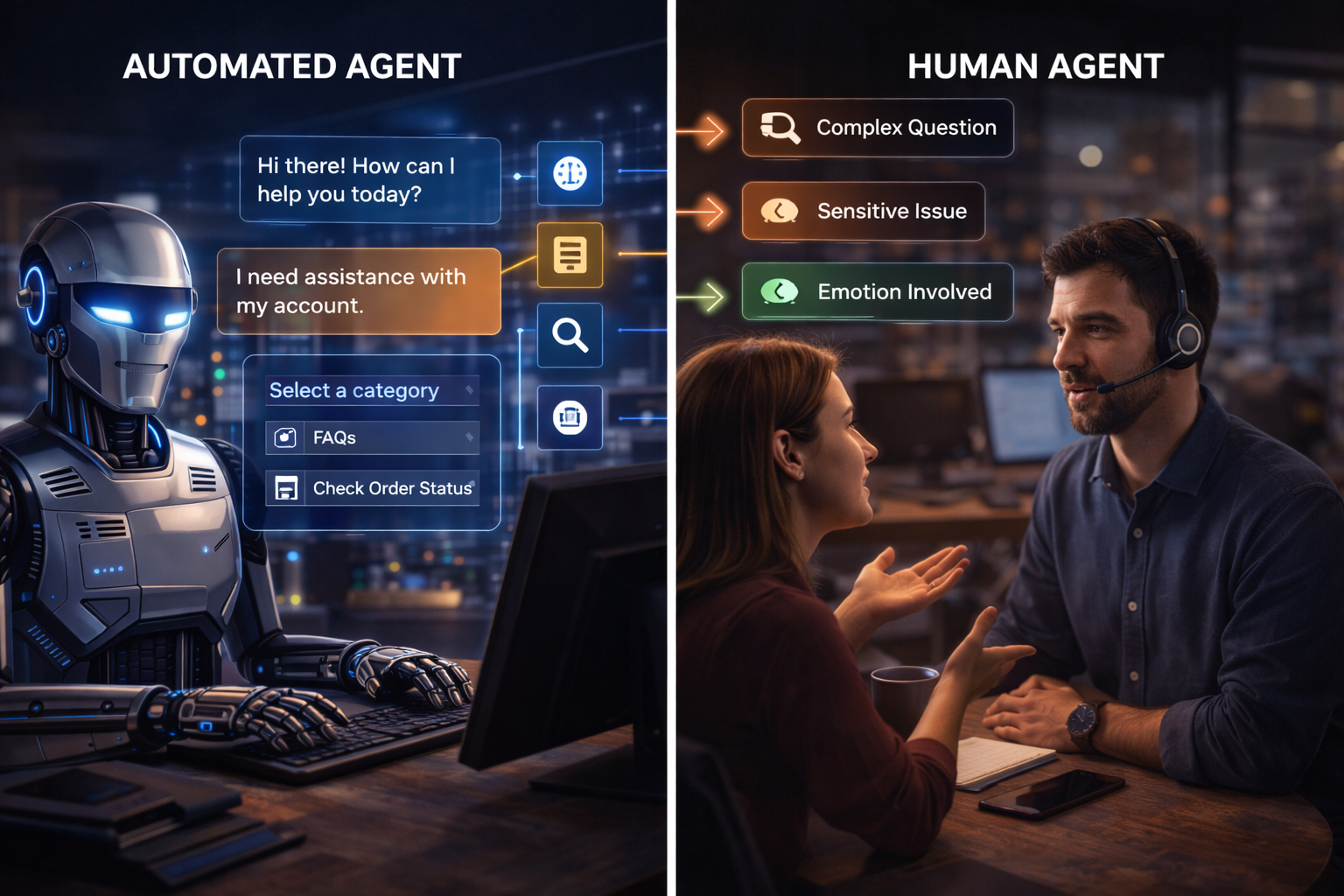
Automating customer service does not mean automating everything.
This is one of the most important — and most ignored — points when companies start using AI in their operations.
The right question is not "what can be automated?".
It is:
what should be automated and what still relies on people to work well?
Where the agent usually works best
A customer service agent tends to work exceptionally well in situations such as:
- initial response
- FAQ
- basic triage
- information collection
- routing
- context retrieval
- status updates
These scenarios share something in common: repetition, predictability, and low risk.
Where human flow remains essential
Human contact usually remains critical when there is:
- sensitive negotiation
- complex exception handling
- delicate conflict or complaint resolution
- strong emotional context
- out-of-rule decision making
- need for subjective interpretation
In these cases, automation can help, but it should not serve as the final layer.
A simple criteria to decide
Four questions help tremendously:
1. Is the task repetitive?
If yes, automation tends to work better.
2. Is the expected output predictable?
If yes, the agent becomes a stronger asset.
3. Is the error reversible or critical?
If the error is critical, greater human supervision is required.
4. Is there a genuine need for human judgment?
If yes, the workflow should not be entirely automated.
The best design is usually hybrid
In the vast majority of cases, the best result stems neither from a completely human system nor a completely automated one.
It comes from a hybrid model:
- the agent handles intake and organization
- the human takes over where nuance, decision-making, or sensitivity exists
This architectural design usually generates:
- greater speed
- improved consistency
- reduced overload
- a superior customer service experience
Conclusion
Customer service automation works best when it respects the proper role of each layer.
AI can accelerate, organize, and reduce friction. The human remains decisive where context, judgment, and relationships truly matter.
Want to design a more efficient customer service operation without losing quality?
Aurion Studio structures agents, workflows, and hybrid customer service models for companies demanding better responses, greater consistency, and near-zero operational friction.
Related articles
Related solutions
Agents & Automation
Need help implementing this strategy?
Aurion Studio helps companies transform concepts into real AI-powered growth systems.